


The injury list that wouldn’t stop growing
In the 2025 MLS season leading up to MLS Cup, the phrase “Vancouver Whitecaps injury crisis 2025” sounded like a reason to write off the campaign. Instead, it became the backdrop to the club’s best-ever run in Major League Soccer. Vancouver finished as Western Conference champions and reached their first MLS Cup in club history, even though they spent most of the year without a full-strength squad.
The problems started early and never truly stopped. Left-back Sam Adekugbe suffered a serious Achilles injury on international duty and was ruled out for the rest of the 2025 season. That one blow took away a key defensive leader and an important outlet on the left flank. Not long after, centre-back Ranko Veselinović tore the ACL in his left knee. He had been a cornerstone of the back line and often wore the armband, so losing him removed both stability and leadership from the defence.
Those headline injuries were only part of the story. Depth defenders picked up calf and knee problems, forcing Vancouver to sign reinforcements mid-season just to keep numbers in the back line. In attack and midfield, knocks and muscle issues reduced rotation options and left the coaching staff constantly shuffling line-ups.
Most importantly, captain and playmaker Ryan Gauld missed a long spell with a knee problem during the heart of the regular season. At one point, the Whitecaps were without their starting left-back, a starting centre-back and their most creative player at the same time. For a club without Premier League-level spending power, this was exactly the kind of situation that usually drags a season into mid-table.
How Jesper Sørensen held everything together
Instead of collapsing, the Whitecaps quietly improved as the season went on. First-year head coach Jesper Sørensen arrived with a clear game model: compact without the ball, aggressive when pressing, and vertical when space opened up. More than any individual, that structure became the backbone of the team.
Early in the year, Vancouver often lined up in a 4-3-3, with full-backs pushing forward at carefully chosen moments and midfielders covering wide spaces when the ball was lost. As the Vancouver Whitecaps injury crisis 2025 deepened, the emphasis shifted even more toward collective movement. The message was simple: no matter who played, the shape and roles stayed the same.
The summer arrival of Thomas Müller gave the attack a different dimension. With him on the pitch, Vancouver leaned into a 4-2-3-1 shape that allowed Müller to operate as a free No. 10 between the lines. His movement dragged defenders out of position, linked midfield to attack and created room for runners like Brian White. Crucially, the structure behind him never changed. The double pivot in midfield shielded a patched-up back line, the wingers tracked back to support their full-backs, and the defensive block stayed narrow enough to protect the penalty area.
Because of this, replacement defenders were not left exposed in constant one-v-one duels, and squad players did not feel like temporary stop-gaps. Sebastian Berhalter developed into a reliable engine in midfield, Brian White turned into a consistent goalscoring threat, and Tristan Blackmon emerged as a defensive leader. The Vancouver Whitecaps injury crisis 2025 forced the coach to dig deep into the roster, and the players responded by turning a fragile-looking group into a robust unit.
From survival mode to an MLS Cup run
Results turned a survival story into a real title push. Despite ongoing injuries and off-field noise around the club’s long-term direction, Vancouver climbed to the top of the Western Conference and stayed there. They learned how to manage tight games, grind out points away from home and win even when the names on the teamsheet looked far from ideal.
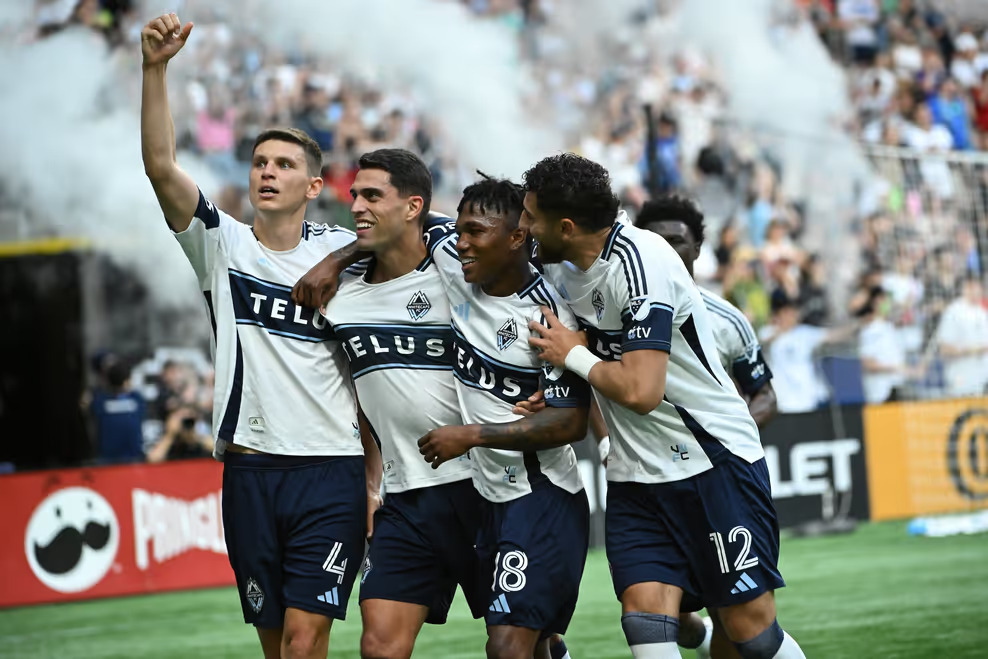
The Western Conference final in San Diego became the clearest statement of their resilience. Against a high-flying expansion side in a sold-out stadium, the Whitecaps won 3–1. Brian White scored twice, the attack flowed through Müller, and a defence missing original starters managed long spells of pressure with calm control. That performance summed up the entire Vancouver Whitecaps injury crisis 2025: a team that should have been overwhelmed by absences instead played like a group hardened by them.
By the time MLS Cup kicked off, Vancouver no longer felt like a side held together with tape. They looked like a squad that had already stress-tested every part of its game model and mentality. Whatever happened in the final itself, the journey there could not be separated from the injuries that had forced so many solutions during the year.
What the 2025 injury crisis says about MLS depth
The Vancouver Whitecaps injury crisis 2025 raises a bigger question for MLS fans in the United States: can clubs really cope with a long season, cross-continent travel and international duty without falling apart when injuries hit? Critics have often argued that many MLS rosters are too top-heavy, built around a handful of star names with limited depth behind them.
Vancouver’s 2025 campaign pushes back against that idea. They lost a starting full-back and a starting centre-back to season-ending injuries. Their captain and most creative player missed a large chunk of the year. Depth players were thrown into starting roles, and teenagers or lesser-known names were forced to grow up quickly. Despite all that, the club finished as Western Conference champions and reached their first MLS Cup.
At the same time, the story is a warning. The physical price of this run has been steep: torn ligaments, an Achilles rupture and repeated lower-body problems. The demands of the modern MLS calendar make serious investment in sports science, medical staff and load management essential rather than optional. The Whitecaps showed what can happen when culture and structure are strong, but they also showed how fragile success becomes when too many key players go down.
Why this season will be remembered
Even now that MLS Cup 2025 is in the books, the Vancouver Whitecaps injury crisis 2025 remains one of the defining stories of the season. It is the year a patched-up squad refused to accept its limits, trusted its system and turned a run of bad luck into fuel for their best-ever campaign. For anyone searching beyond the scorelines, this is the narrative that will keep drawing fans back to Vancouver’s 2025 season and to what resilience can look like in MLS.

Blair Kensington is specialized in data-driven match context, tactical trends, and AI-assisted performance insights. With a focus on turning complex metrics into clear narratives, Blair covers major leagues and international competitions through the lens of probability, form cycles, and underlying numbers. His work helps readers understand why results happen, not just what happened.