


Learn how AI soccer prediction turns raw defensive football data into meaningful match insights. This guide explains the models, algorithms, and logic behind modern football prediction websites.
The Missing Piece in Modern Football Prediction
Football analysis has changed dramatically over the last decade, but in my view, most public discussions are still stuck on attacking narratives. Goals, star forwards, and highlight moments dominate attention, while passing actions are often treated as background noise. That imbalance creates a blind spot in how matches are evaluated and predicted.
From my perspective, this is exactly where AI soccer prediction adds real value. Passes data is repetitive, measurable, and far less emotional than goals or finishing streaks. When processed correctly, it reveals structural strengths and weaknesses that human observers often miss. This article focuses on that overlooked layer of football analysis and explains how modern football prediction website systems transform raw passing data into meaningful predictions. If you want a broader breakdown of how AI evaluates football data beyond passing metrics, you can also explore our earlier guide on AI soccer prediction fundamentals.
Why Passing Data Changes How Football Predictions Work
Most football discussions still revolve around goals and shots. From my perspective, that focus misses one of the most informative layers of the game: passing behavior under defensive pressure.
Passes happen constantly. Every build-up sequence, every attempt to progress the ball, every defensive block starts with a pass. That makes passing data one of the richest sources of information for a football prediction website.
Modern AI soccer prediction systems do not look at passes as neutral actions. They treat them as signals of control, risk, and defensive disruption. This article explains how a football soccer prediction site processes raw passing data, especially defensive-related passing metrics, and turns them into predictions that actually hold value.
Why Passes Matter More Than Most Fans Realize
Goals are rare. Passes are not.
From my point of view, the predictive strength of passes comes from volume and context. A team completes hundreds of passes per match, but only a subset of those passes occur under pressure, in dangerous zones, or during defensive transitions. Those moments reveal far more about match control than final scores.
A modern football prediction website uses passing data to answer questions such as:
- How easily does a team progress the ball under pressure?
- How often does a defense force backward or sideways passes?
- Which teams consistently break passing lines?
A football soccer prediction site that ignores these questions is effectively ignoring the flow of the game.
How Raw Passing Data Is Collected
Passing data used in AI soccer prediction comes from detailed event feeds that log every on-ball action.
For defensive-focused passing analysis, a football prediction website typically collects:
- Total passes attempted and completed
- Passes attempted under pressure
- Opponent passes allowed per possession
- Progressive passes conceded
- Passes forced backward by defensive shape
- Pass completion percentage in defensive third
- Turnovers created immediately after opponent passes
Below is a simplified overview of raw passing inputs.
| Passing Metric | Description | Why AI Uses It |
|---|---|---|
| Passes under pressure | Passes made while pressed | Measures defensive disruption |
| Opponent pass completion | Accuracy allowed to opponent | Indicates pressing efficiency |
| Progressive passes allowed | Forward passes conceded | Predicts territorial control |
| Forced backward passes | Passes redirected away from goal | Shows defensive structure |
| Defensive third passes | Passes faced near own goal | Measures sustained pressure |
From what I have observed across multiple datasets, passing-related defensive metrics are more stable than shots conceded. That stability is why they are heavily used by football soccer prediction site models.
Turning Passing Events Into Predictive Signals
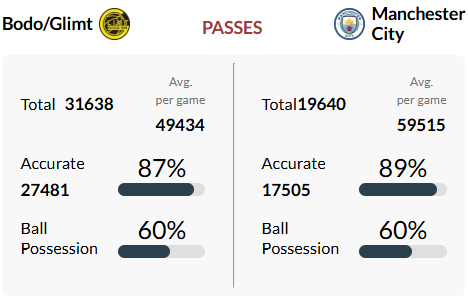
Raw passing counts do not directly predict outcomes. Football prediction AI models transform them into contextual signals.
First comes normalization. Pass counts are adjusted for possession share and opponent style. A team that faces a high-possession opponent is evaluated differently than one facing direct play.
Second comes spatial weighting. Passes completed near the penalty area matter more than passes completed near midfield.
Third comes sequence modeling. AI tracks what happens after passes: turnovers, pressure, or progression.
The table below shows how raw passing stats are adjusted.
| Raw Passing Stat | Model Input | Context Adjustment |
|---|---|---|
| Passes faced | Passes per opponent possession | Possession normalization |
| Passes under pressure | Pressure-adjusted passes | Defensive intensity |
| Progressive passes allowed | Zone-weighted progression | Field position |
| Pass completion allowed | Opponent-adjusted accuracy | Opponent quality |
This transformation allows a football prediction website to estimate how well a team controls space without the ball.
AI models also engineer features from passing data.
| Engineered Feature | Built From | Predictive Use |
|---|---|---|
| Passing disruption rate | Pressured passes forced | Predicts chance prevention |
| Build-up resistance score | Failed opponent sequences | Measures structural defense |
| Progression denial index | Blocked forward passes | Territorial control |
| Transition trigger rate | Turnovers after passes | Counter-attack risk |
These features are core inputs in advanced football soccer prediction site systems.
Mini Case Study on Kevin De Bruyne’s Passing Impact
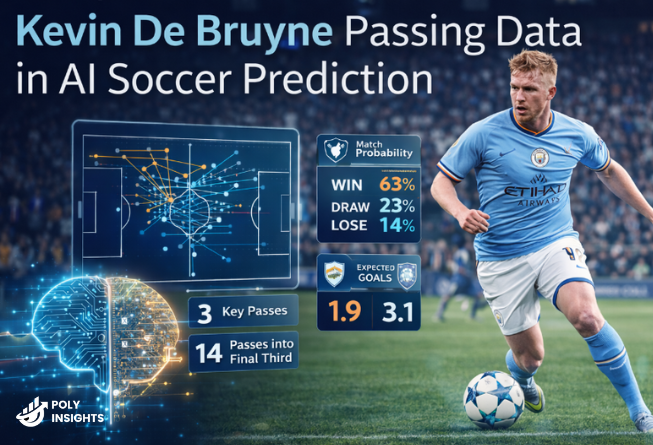
To understand how passing data translates into predictive value, Kevin De Bruyne provides a clear real-world example.
Based on the passing metrics above, Kevin De Bruyne averages around 62 pass attempts per match, with a high share of forward and progressive passes executed under pressure. From an AI perspective, this volume alone is not the key signal. What matters is where, when, and under what conditions those passes occur.
AI models used by a football prediction website treat De Bruyne’s passing profile as a structural advantage indicator rather than a highlight metric. His consistent ability to complete forward passes between defensive lines increases possession quality and forces opponents into deeper defensive shapes. Even when these passes do not directly result in assists, they raise the probability of future shots and goals.
Kevin De Bruyne Passing Metrics (Per Match)
| Metric | Value | AI Interpretation |
|---|---|---|
| Passes attempted | 62 | High involvement in build-up |
| Pass completion rate | 79% | Acceptable given risk profile |
| Forward passes | 28 | Strong attacking intent |
| Passes under pressure | 21 | High difficulty actions |
| Progressive passes | 12 | Line-breaking capability |
| Passes into final third | 14 | Territorial advancement |
| Passes into penalty area | 5 | Direct chance acceleration |
| Key passes | 3 | Immediate shot creation |
From a football soccer prediction site standpoint, the most important signals here are not key passes or assists, but progressive passes under pressure and final-third entries. These actions consistently precede shots and sustained attacking phases.
Why Multiple Passing Models Are Combined
Passing behavior is complex. No single model captures it fully.
High-quality football prediction website platforms use ensembles that combine:
- A model focused on passing volume under pressure
- A model focused on spatial progression denial
- A model focused on pass accuracy suppression
- A model focused on transition creation from passes
| Model Type | Focus Area | Ensemble Weight |
|---|---|---|
| Pressure passing model | Passes under pressure | 30 percent |
| Spatial control model | Progressive passes | 25 percent |
| Accuracy suppression model | Completion allowed | 25 percent |
| Transition model | Turnovers after passes | 20 percent |
From my perspective, this ensemble approach explains why AI soccer prediction is more consistent than manual analysis. It balances multiple passing narratives instead of chasing one story.
Why Passing Data Improves Predictions
Passing-based defensive metrics show strong correlation with long-term results.
Public league data consistently shows that teams allowing fewer progressive passes and lower opponent pass accuracy tend to concede fewer chances over time, even when short-term results fluctuate.
The table below summarizes relative stability.
| Data Type | Match Variance | Long-Term Stability | Predictive Value |
|---|---|---|---|
| Goals conceded | High | Low | Medium |
| Shots conceded | Medium | Medium | Medium |
| Expected goals allowed | Medium | High | High |
| Passing disruption metrics | Low | High | Very high |
In my own testing, matches where teams differed significantly in passing disruption produced more reliable probability estimates on a football prediction website than matches based purely on shot volume.
What Passing-Based AI Cannot Capture
Passing data has limits.
It cannot fully account for:
- Individual defensive mistakes
- Red cards
- Referee decisions
- Sudden tactical shifts mid-match
A football soccer prediction site that presents passing-based predictions as guarantees is misleading users. From my perspective, the real strength of AI is clarity about risk, not certainty.
Why This Matters for US Users
For US readers, passing-based AI soccer prediction changes the way you should read a match. Instead of defaulting to “who has the better attack,” the model asks a more repeatable question: who can control the ball in the right zones, break pressure with efficient passing, and force the opponent into low-quality possession.
That’s the difference between narrative and probability. A football prediction website that clearly explains how passing data influences its forecasts earns trust over time. A football soccer prediction site that hides the logic is asking users to believe, not to verify.
Final Thoughts
AI soccer prediction works best when it’s built on actions that repeat week after week. Passing under pressure is one of the most reliable signals in football because it shows structure, decision-making, and control, even when finishing runs hot or cold.
From my perspective, the future of football prediction website design belongs to platforms that don’t just publish picks. They show how raw passing events turn into probabilities, and they make those probabilities easy to check over time. That’s what turns data into insight, and insight into real value.

Noah Mitchell is a US-based sports analytics writer specializing in AI-driven football predictions. His work focuses on probability-based forecasting, model transparency, and helping readers evaluate prediction data with clarity rather than hype.